
Moving to Thailand for retirement starts with one essential piece of paperwork: the retirement visa. Officially called the Non-Immigrant O-A visa – with a longer-stay cousin known as the O-X – this is what allows anyone aged 50 or older to live in Thailand long-term without working. The requirements can look intimidating on paper: bank balances, insurance certificates, 90-day reports. But broken down step by step, the process is very manageable, and tens of thousands of retirees successfully navigate it every year. Here’s exactly what you need to know.
What Is the Thailand Retirement Visa?
The Thailand retirement visa is a long-stay Non-Immigrant visa reserved for foreigners aged 50 and above who want to live in the country without engaging in paid work. It isn’t a single fixed product – it’s really a small family of options (O-A, O-X, and the newer Long-Term Resident visa) that share the same basic purpose but differ in length, cost, and who qualifies.
Unlike a tourist visa, which is designed for short stays, the retirement visa is built around annual renewal from inside Thailand, which means that once you’re set up, you generally don’t need to leave the country each year just to keep your legal status current. It does, however, come with ongoing obligations – proof of funds, address reporting, and (for most categories) mandatory health insurance – that you’ll need to maintain for as long as you stay.
Eligibility Requirements
Age and Employment Criteria
The baseline requirement is straightforward: you must be at least 50 years old on the date you apply, and you must not work in Thailand under this visa category. “Work” is interpreted broadly by Thai law, so even unpaid volunteer roles or informal consulting can technically require a work permit. If you want to earn income while living in Thailand, the retirement visa isn’t the right vehicle – you’d need to look at a different visa category entirely.
Financial Requirements
This is where most applications succeed or fail, so it’s worth getting precise. To qualify, you’ll typically need one of the following:
A Thai bank deposit of at least ฿800,000, held in your name for a minimum of two months before you apply (and kept above a minimum balance throughout the visa year), or
A monthly pension or income of at least ฿65,000, documented through official statements, or
A combination of savings and monthly income that adds up to the ฿800,000 annual equivalent.
Immigration officers do check bank balances at renewal time, and letting the account dip too low – even briefly – is one of the most common reasons applications get flagged. If your income comes from abroad, keep certified statements and, where possible, an income confirmation letter from your home country’s embassy in Bangkok.
Health and Insurance Requirements
Since 2019, health insurance has been mandatory for the O-A visa. As of 2026, the minimum coverage required is ฿40,000 for outpatient treatment and ฿400,000 for inpatient (hospitalization) treatment per year, from an insurer approved by Thailand’s Office of Insurance Commission. This isn’t a box-ticking formality – immigration officers verify the insurance certificate directly, and coverage has to stay active for the life of the visa.
One detail that catches people off guard: insurance eligibility gets harder, not easier, with age. Some insurers stop accepting new applicants over 60, and a few won’t cover anyone over 70. It’s worth sorting out your insurance early in the planning process, before you commit to flights or lease a condo, since it can end up being the factor that determines whether the whole plan is workable.
Types of Retirement Visas: O-A, O-X, and LTR
O-A Visa (1 Year, Renewable Indefinitely)
The O-A is the classic retirement visa: a one-year, multiple-entry permit that you can renew annually from inside Thailand for as long as you continue to meet the requirements. It’s the most flexible and widely used option, and it’s usually the right starting point if you’re not yet sure how long-term your move will be.
O-X Visa (Long-Term, Up to 10 Years)
The O-X offers a longer runway – five years initially, renewable once for another five, for ten years total – but it’s only available to nationals of a specific list of countries (including the US, UK, Canada, Australia, and several European nations). It also requires a longer remaining passport validity (36+ months, versus 18+ months for the O-A) and generally higher financial thresholds. If your home country is eligible and you’re confident Thailand is where you want to settle, it can mean fewer renewal cycles to manage.
Long-Term Resident (LTR) Visa
The LTR is a newer, separate visa track aimed at higher-net-worth retirees. Under its “Wealthy Pensioner” category, applicants typically need to show annual passive income of at least $80,000 USD, or a qualifying deposit of $250,000 USD in Thai assets. In exchange, the LTR offers a 10-year visa and, for qualifying income, more favorable tax treatment than the standard retirement visa route. It’s a narrower path – most retirees won’t meet the income threshold – but worth knowing about if it fits your financial picture.
How to Apply for a Thailand Retirement Visa
Applying From Abroad (O-A Route)
The traditional route is to apply for the O-A visa at a Thai embassy or consulate in your home country before you travel. You’ll submit your financial and insurance documentation there, and if approved, you arrive in Thailand with the full one-year visa already in hand. This route front-loads the paperwork but means you land already settled, without needing to make a visa run partway through your first year.
Converting a Tourist Visa Inside Thailand
Many retirees instead enter Thailand on a tourist visa or a 90-day Non-Immigrant O visa, then convert it to a full retirement visa at a local immigration office once they’ve decided to stay. This route can be more forgiving on timing – you can shop for insurance and open a Thai bank account after you’ve already arrived – but you must complete the conversion within your current visa’s validity window, and your initial application will still need to meet the same financial and insurance standards.
Document Checklist
While requirements vary slightly by embassy and by immigration office, plan to gather:
A passport with at least 18 months of remaining validity (36 months for O-X)
A completed visa application form and recent passport-style photos
Bank statements or an official bank letter confirming your deposit or income
A police clearance / criminal background check from your home country, usually issued within the last three months
A medical certificate from an approved clinic or hospital
Proof of health insurance meeting the minimum coverage levels
Visa Maintenance and Renewal
Annual Extensions and 90-Day Reports
Your visa needs to be extended annually at a Thai immigration office, where you’ll re-verify your financial and insurance standing. Separately, every long-term visa holder must file a 90-day address report confirming where they’re living – this can usually be done by mail, online, or in person. Missing a 90-day report typically triggers a fine (around ฿2,000) and repeated lapses can put your visa status at risk, so it’s worth setting a recurring reminder.
Tips for a Smooth Renewal
Keep your required bank balance untouched for the full two months before renewal, hold on to every insurance receipt and certificate, and apply for a re-entry permit before any trip outside Thailand – without one, leaving the country can cancel your visa outright. Many retirees also find it worthwhile to use a visa agent for the first renewal or two, simply to learn the local immigration office’s specific paperwork preferences, which can vary slightly from office to office.
Common Pitfalls to Avoid
The most frequent stumbling blocks are: letting the bank balance fall below the minimum even briefly, being caught without a re-entry permit after leaving Thailand, missing a 90-day report deadline, and misunderstanding which type of income counts toward the financial requirement. None of these are difficult to avoid once you know they’re coming – which is really the point of planning this out ahead of time rather than learning the hard way.
Questions fréquemment posées
Qui est éligible au visa de retraite de la Thaïlande ?
Les demandeurs doivent être âgés d'au moins 50 ans, ne doivent pas travailler en Thaïlande et doivent satisfaire aux exigences financières, généralement 800 000 bahts sur un compte bancaire thaïlandais ou 65 000 bahts de revenu mensuel (ou une combinaison admissible des deux).
Quels sont les documents nécessaires ?
Les exigences standard comprennent votre passeport, une preuve financière (lettres de banque ou relevés de pension), un certificat de bonne conduite, un certificat médical, des photos d'identité et, pour le visa O-A, une preuve d'assurance maladie admissible.
Puis-je demander le visa de retraite depuis la Thaïlande ?
Oui. De nombreuses personnes entrent avec un visa touristique ou un visa Non-Immigrant O de 90 jours et le convertissent en visa de retraite dans un bureau de l'immigration thaïlandaise, puis le renouvellent chaque année. Assurez-vous simplement que la conversion a lieu avant l'expiration de votre visa actuel.
Combien coûte le visa ?
Les frais gouvernementaux sont relativement modestes – généralement autour de 1 900 à 2 000 bahts pour une prolongation annuelle, auxquels s'ajoutent des frais distincts pour un permis de réentrée (environ 1 000 bahts pour une entrée simple, 3 800 bahts pour des entrées multiples) si vous prévoyant de voyager. Les montants exacts pouvant changer, veuillez confirmer les tarifs en vigueur auprès de votre bureau d'immigration local.
Combien de temps puis-je rester avec ce visa ?
Le visa O-A est valable un an et renouvelable chaque année et indéfiniment, tant que vous continuez à remplir les conditions requises. Le visa O-X est accordé pour deux blocs de cinq ans, soit une durée maximale de dix ans.
Mon conjoint peut-il rester avec moi ?
Oui, un visa dépendant est disponible pour le conjoint (et dans certains cas les enfants), partageant généralement les mêmes critères financiers dans le cadre d'une demande combinée.
Qu'est-ce que le rapport de 90 jours et que se passe-t-il si l'on en manque un ?
Il est obligatoire pour tous les titulaires d'un visa de longue durée de confirmer leur adresse actuelle auprès des services d'immigration tous les 90 jours, ce qui peut généralement se faire par courrier ou en ligne. Le non-respect de ce délai entraîne généralement une amende, et des manquements répétés peuvent compromettre le statut de votre visa.
What happens if I leave Thailand while on this visa?
You need a re-entry permit before you travel. Without one, the retirement visa is automatically canceled the moment you exit the country, even if it was otherwise still valid.
Visa rules, fees, and financial thresholds are set by Thai immigration authorities and can change. This article is intended as a general guide — always confirm current requirements with the Thai Immigration Bureau, a Thai embassy/consulate, or a licensed Thai immigration adviser before you apply.
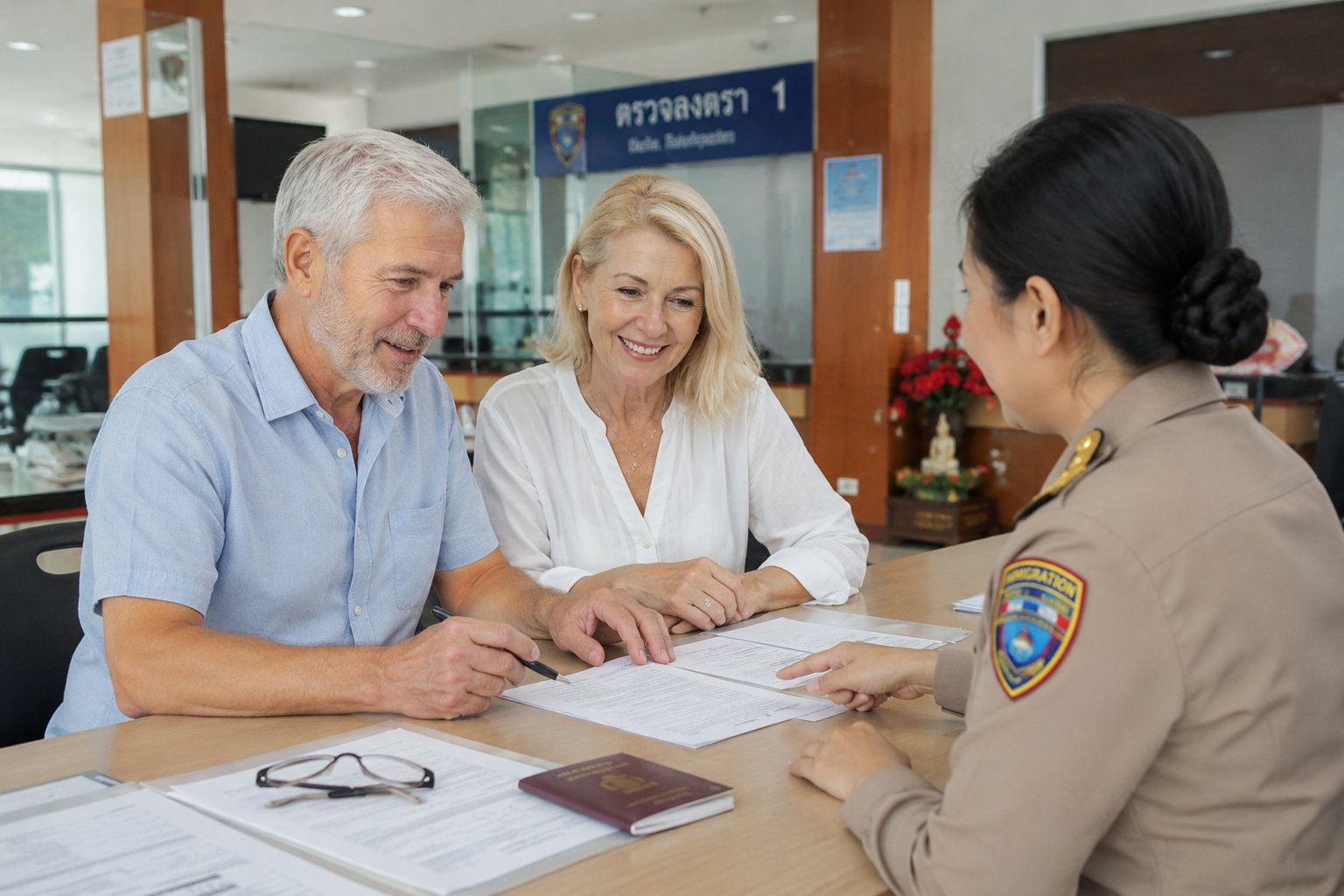
If navigating the visa process feels like a lot to manage from a distance, you’re not alone it’s one of the most common concerns we hear from families planning a move to Homerly Senior Living. Our team can point you toward reputable visa agents and walk you through how the timing fits with move-in planning, so paperwork is one less thing to worry about.